



SEARCH ENGINE OPTIMISATION (SEO)

Search Engine Optimisation is the process of improving your website’s visibility amongst millions of other sites. It pushes you higher up the rankings in searches.
To get to the top of a page straight away, you can always pay for an ad with Google Ads or Microsoft Advertising so that you are one of the first few sponsored names that users see. But that comes with the condition that you will only stay there for as long as your ad is running.
If that’s not something you want, there are many other options to try, which will help your visibility grow naturally.
Keywords
Think about the books you have written and the keywords that people will type into search engines when they look for a work like yours. Will they use your name, your genre, your topic, or a location? Whatever your unique selling point is, this must be obvious on your website. Make your headings match the keyword descriptions; include popular phrases in your blurbs and explanations; place a caption under every photo to match a typical keyword search. The easier it is to match keywords to your content, the easier it will be for people to find you.
Meta Tags
These are found in the SEO settings of your website. If you don’t know where they are, ask a search engine, or Chat GPT, for help. For example: ‘Where do I update the meta tags settings on my Wix website?’
The reason they are so important is that they affect what is displayed when the keyword searches appear.
The example below shows what happened when I typed ‘crime fiction in Devon and Cornwall ' into Google.
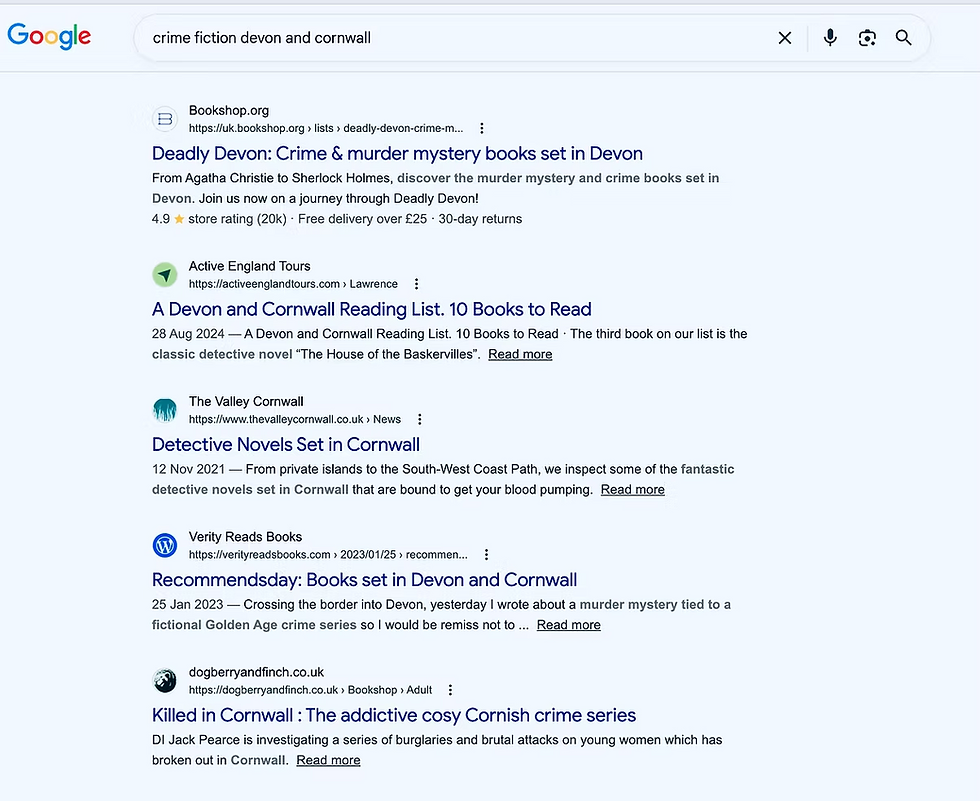
The title tag is the blue clickable headline, and the meta description is the grey writing that follows.
If you don’t put anything in your meta tags on your own website, Google will make them up for you. But if you write them yourself, you have a free shop window to hook a reader by telling them exactly what you want to say.
Which of the links in the above image would encourage you to click on them? Which ones would you scroll past?
Putting meta tags for every page on your website is undoubtedly time-consuming, but it is also worthwhile. Be sure to include your keywords/ locations/ genre, etc., in your meta description to make a user curious enough to encourage a click.
Content
It goes without saying that your website content must be professional and informative. Look at it now with fresh eyes and see if it can be improved. Does it look dated? Does it need more images? Do your photos need replacing?
If you have a blog on your site, you should post frequently to show readers you are enthusiastic about your topic. If there are places for people to leave comments, you should reply to them within 24 hours. A stagnant site makes visitors feel you’re not bothered, and they will find their next read elsewhere.
Linked Pages

When someone clicks on your site, your SEO rankings improve considerably if they decide to stay. A simple way to make this happen is to provide obvious links between your pages. This might be a BACK and NEXT button at the bottom of each page to encourage them to click forward, or if you have pages set up for character profiles, link to these from the main description.
Simple links embedded in a photo work well, or put them in a bolder font. If possible, make these links open in a new window and give a clear route back to the page readers came from. This reduces user frustration and makes readers more likely to return or share your site with a friend.
Backlinks
Backlinks are another sure way of making your site rise up the search engine rankings. This is where another site with a bigger reputation than yours includes your link on theirs. If a lot of traffic is coming in from a site the search engine already trusts, this improves its likelihood of pointing visitors in your direction.
Ensure your website is linked to your social media and any other sites you are on (e.g. Goodreads, writing groups, etc.). Do you know any influencers or local businesses that would welcome a contribution from you in the form of an article or a free book? Would they be willing to put a link from their site to yours? The more widely people see your name, the stronger your reputation and visibility will be when they come across it again.
Mobile Friendliness

The majority of casual scrolling is done by readers on a mobile phone, and so your website must be optimised to be viewed clearly this way. Website providers offer a desktop and a mobile view when setting up the pages, so be sure to check both versions when you upload to see that they are properly aligned.
Make sure that the upload speed is fast enough by removing unnecessary videos or complex pages that slow it down. If someone has to wait for more than a couple of seconds to see your information, or if your pages are not presented in a neat and tidy way, then they will go elsewhere, and your SEO rankings will drop.
Secure sites
Make sure your website opens with https:// and not http://. Most major website hosts offer this as standard or as part of a package, so it should be easy enough to do. But if you are still linked to an older site that has no SSL certificate, or if you are on a very cheap package, this is worth looking into. Sites with SSL certificates are always prioritised by search engines.
Monitor Results
Your website host will have a page where you can monitor your website traffic. This tells you such things as: which pages are the most popular, how long visitors stay on the site, what devices they viewed it on, how they found you and where they are from. This provides vital information about your readers’ demographic and what content they like the most. From this, you gain a greater knowledge of your readership and so can provide more pages to appeal to them.
In summary, SEO optimisation is not a quick fix and requires perseverance and effort. But it's certainly worth doing and not something you should ignore.


The point about paid ads only working while you keep paying is spot on—organic SEO is definitely the smarter long-term investment. I've been using a tool that tracks keyword shifts daily, which helps me see exactly when my content starts climbing, check out https://veovideoai.com
The point about paid ads only lasting as long as you fund them is spot on—organic SEO is the only real long-term investment. I’ve been using a tool that tracks my keyword drift daily, which you can check out at https://glbviewer.com
The point about paid ads being temporary is so true—organic SEO is the only way to build lasting visibility. I've been using a tool that tracks keyword drift daily, which helps me see exactly where those sponsored spots end and real rankings begin. https://ai-3d-model-generator.com
The point about paid ads only lasting as long as you fund them is spot on—organic SEO is the only real long-term investment. I’ve been digging into a tool that tracks keyword drift daily, which helps me see exactly where my content is slipping before I lose rank, check out https://flux3.site
The point about paid ads being temporary is spot on—organic SEO is definitely the longer game, but it’s worth it for lasting results. I’ve been using a tool that tracks keyword shifts daily, which helps me see what’s actually moving the needle, check out https://faceless-video.net